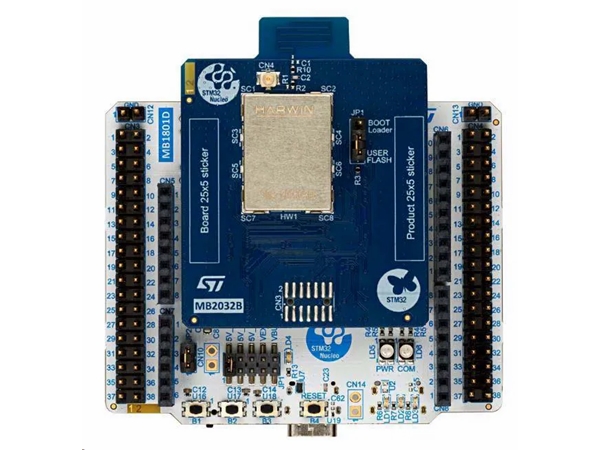

Development Board, STM, ARM Cortex-M0+, 32Bit, Nucleo-64 RF
Varenr:
H49719
EAN:
5705412497190
STMicroelectronics STM32 Nucleo-udviklingskort er designet til at understøtte brugere, der ønsker at blive fortrolige med funktionerne i hele STM32 MCU-familien. Disse kort er ideelle til hurtig prototyping, og den standardiserede tilslutningsmulighed giver designeren mulighed for at bygge og genbruge tilføjelseshardware på tværs af hele porteføljen af Nucleo-kort. Kortstikkene er kompatible med Arduino, og et nyt standardiseret ST-stik (Morpho) giver adgang til alle IO'er, der er tilgængelige på MCU'en.
Kortet leveres med brugsklare softwareeksempler og understøttes af IAR- og Keil-udviklingsværktøjer samt GCC-baserede IDE'er. Hvert af disse kort indeholder en ST-LINK/V2-1 in-circuit debugger og programmerer, som kan bruges enten med den indbyggede MCU eller - i standalone-tilstand - med andre applikationer, der indeholder en STM32 MCU.
X-CUBE-MCSDK STM32 Motor Control Software Development Kit (MCSDK) gør design af motorstyring nemmere og hurtigere. MCSDK-firmwaren (motor control software development kit) (X-CUBE-MCSDK og X-CUBE-MCSDK-FUL) inkluderer firmwarebiblioteket til permanentmagnetsynkronmotorer (PMSM) (FOC-styring). STM32 Motor Control Workbench (til konfiguration af parametrene for FOC-firmwarebiblioteket) er også inkluderet i den grafiske brugergrænseflade (GUI).
Egenskaber:
- STM32 mikrocontroller med LQFP64-pakke
- To typer udvidelsesressourcer
- Arduino Uno Revision 3-forbindelse
- STMicroelectronics Morpho-udvidelsesstiftlister for fuld adgang til alle STM32 I/O'er
- Indbygget ST-LINK/V2-1 debugger/programmerer med SWD-stik
- Valgtilstandsskift til brug af kittet som en selvstændig ST-LINK/V2-1
- Fleksibel strømforsyning til board
- USB VBUS eller ekstern kilde (3,3V, 5V, 7V til 12V)
- Strømstyringsadgangspunkt
- mbed-aktiveret (mbed.org)
- Tre LED'er
- USB-kommunikation (LD1), bruger-LED (LD2), strøm-LED (LD3)
- To trykknapper: BRUGER og RESET
- USB-genoptællingsfunktion: tre forskellige grænseflader understøttes på USB
- Virtuel Com-port
- Masselagring
- Fejlfindingsport
- Omfattende gratis HAL-softwarebibliotek inklusive en række softwareeksempler
- Understøttet af et bredt udvalg af integrerede udviklingsmiljøer (IDE'er), herunder IAR, Keil og GCC-baserede IDE'er
STMicroelectronics STM32 Nucleo Development Boards are designed to support users who want to get familiar with the features of the entire STM32 MCU family. These boards are ideal for quick prototyping, and the standardized connectivity allows the designer to build and reuse add-on hardware across the whole portfolio of Nucleo boards. The board connectors are compatible with Arduino, and a new standardized ST connector (Morpho) gives access to all IOs available on the MCU.
The board comes with ready-to-use software examples and is supported by IAR and Keil development tools, as well as GCC-based IDEs. Each of these boards contains an ST-LINK/V2-1 in-circuit debugger and programmer, which can be used either with the onboard MCU or - in standalone mode - with any other applications containing an STM32 MCU.
X-CUBE-MCSDK STM32 Motor Control Software Development Kit (MCSDK) makes motor control design easier and faster. The MCSDK (motor control software development kit) firmware (X-CUBE-MCSDK and X-CUBE-MCSDK-FUL) includes the permanent-magnet synchronous motor (PMSM) firmware library (FOC control). The STM32 Motor Control Workbench (to configure the FOC firmware library parameters) is also included with its graphical user interface (GUI).
Features:
- STM32 microcontroller with LQFP64 package
- Two types of extension resources
- Arduino Uno Revision 3 connectivity
- STMicroelectronics Morpho extension pin headers for full access to all STM32 I/Os
- On-board ST-LINK/V2-1 debugger/programmer with SWD connector
- Selection-mode switch to using the kit as a standalone ST-LINK/V2-1
- Flexible board power supply
- USB VBUS or external source (3.3V, 5V, 7V to 12V)
- Power management access point
- mbed-enabled (mbed.org)
- Three LEDs
- USB communication (LD1), user LED (LD2), power LED (LD3)
- Two pushbuttons: USER and RESET
- USB re-enumeration capability: three different interfaces supported on USB
- Virtual Com port
- Mass storage
- Debug port
- Comprehensive free software HAL library including a variety of software examples
- Supported by a wide choice of Integrated Development Environments (IDEs) including IAR, Keil, GCC-based IDEs
