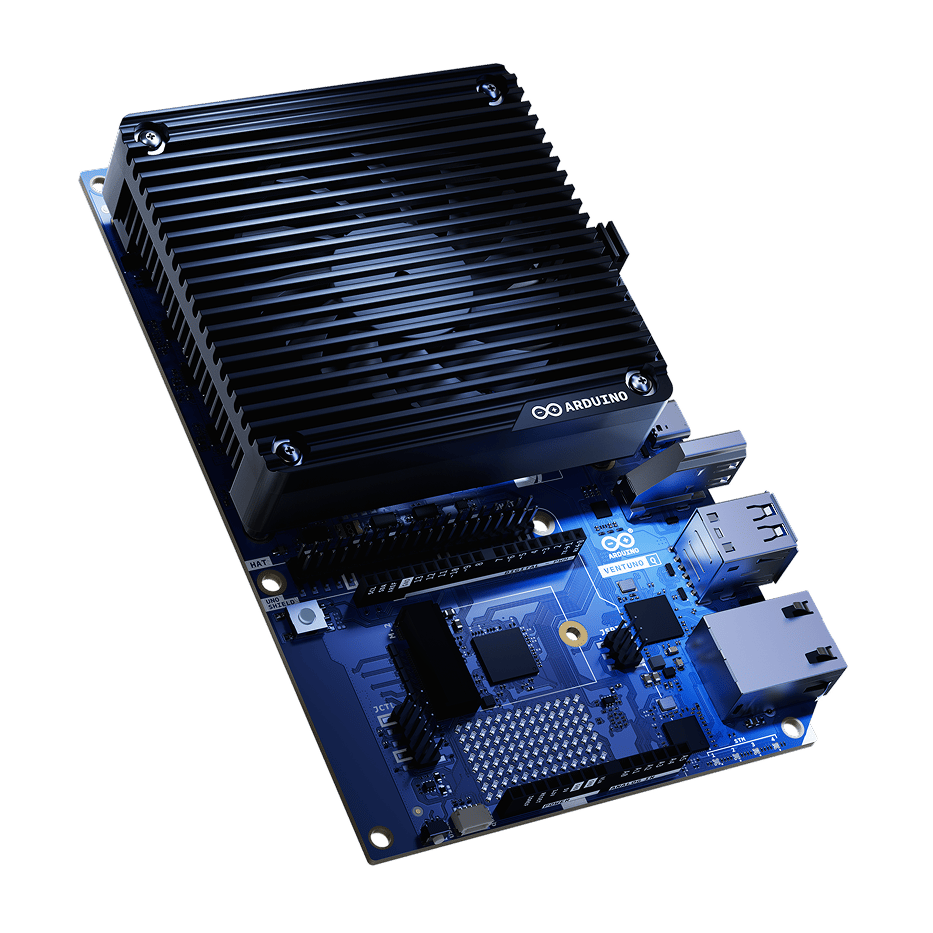

Arduino VENTUNO Q AI SBC - 16GB RAM / 64GB eMMC
Varenr:
H38105
EAN:
5705412381055
Arduino VENTUNO Q er en kraftfuld edge AI-computer bygget til robotics og avancerede AI-anvendelser. Den kombinerer en Qualcomm Dragonwing IQ8-processor med en STM32H5-mikrocontroller i en unik dual-brain arkitektur: den ene side håndterer tung AI-inferens (vision, sprogmodeller, perception), mens den anden garanterer millisekund-præcis, deterministisk styring af motorer og fysiske systemer.
Med op til 40 dense TOPS AI-ydelse, 16 GB LPDDR5-RAM og 64 GB indbygget lagerplads kan VENTUNO Q køre lokale sprog- og synsmodeller (som Qwen og Gemma) helt offline uden cloud-afhængighed og med fuld datasikkerhed. Kortet understøtter ROS 2, er kompatibelt med Arduino UNO-shields, Raspberry Pi HAT'er og Modulino/Qwiic-moduler, og kan udvikles via enten Arduino App Lab eller standard Linux-værktøjer som VS Code og Docker.
VENTUNO Q er den ideelle platform til alt fra intelligente robotter og industriel automation til smarte kiosker, computer vision-systemer og avanceret AI-forskning og tilbyder en klar vej fra prototype til produktion.
Funktioner:
- Dual-brain arkitektur: Qualcomm Dragonwing IQ8 (AI) + STM32H5-mikrocontroller (real-time styring)
- Op til 40 dense TOPS AI-ydelse (NPU, CPU og GPU på samme chip)
- Kører lokale LLM'er og VLM'er (Qwen, Gemma) helt offline ingen cloud nødvendig
- Understøtter computer vision: objektsporing (YOLO-X), positionsdetektion (PoseNet), gestusgenkendelse (MediaPipe)
- Offline tale-til-tekst og tekst-til-tale (Whisper, MeloTTS, Piper)
- Sub-millisekund realtidsrespons til motorstyring og robotics
- ROS 2-kompatibel til avanceret robotudvikling
- Udvidelig med M.2 NVMe-lagerplads (PCIe Gen. 4)
- Kompatibel med Arduino UNO-shields, Raspberry Pi HAT'er og Modulino/Qwiic-moduler
- Udvikles via Arduino App Lab eller standard Linux-værktøjer (VS Code, Python, Docker, SSH)
- Klar vej fra prototype til produktion via "Works with Arduino"-programmet
Tekniske detaljer:
- Mikroprocessor (MPU): Qualcomm Dragonwing IQ-8275 8-core Kryo CPU, Adreno 623 GPU, Hexagon NPU (40 dense TOPS), Spectra 692 ISP. OS: Ubuntu/Debian
- Mikrocontroller (MCU): STM32H5F5 Arm® Cortex® M33 @ 250 MHz, 4 MB flash, 1,5 MB RAM. Arduino core på Zephyr
- RAM: 16 GB LPDDR5
- Lagerplads: 64 GB eMMC + M.2-stik til NVMe Gen. 4-udvidelse
- Konnektivitet: Wi-Fi 6 (2,4/5/6 GHz), Bluetooth 5.3, 2,5 Gbit RJ45
- Kamera: USB-kamera understøttelse + 3x MIPI CSI (2 delt med JMEDIA-header)
- Video: HDMI (delt med MIPI DSI), USB-C DisplayPort Alt Mode
- Lyd: 2x mikrofonindgang, hovedtelefon-/øreudgang, line-out
- Strømforsyning: USB-C (5V/3A), 5,5x2,1 mm strømstik (1224V), skrueterminal (724V)
- USB: 1x USB-C (host/device), 2x USB 3.0 Type-A, 2x USB 3.0 på JOMEGA-header
- CAN: 1x CAN-FD (PHY) på skrueterminal, 3x CAN-FD på JOMEGA, 1x CAN-FD på UNO shield headers
- Operativsystem: Denian, Ubuntu
- Mål: 160 x 100 x 25,8 mm
Arduino VENTUNO Q is a powerful edge AI computer built for robotics and advanced AI applications. It combines a Qualcomm Dragonwing IQ8 processor with an STM32H5 microcontroller in a unique dual-brain architecture: one side handles heavy AI inference (vision, language models, perception), while the other guarantees millisecond-precise, deterministic control of motors and physical systems.
With up to 40 dense TOPS of AI performance, 16 GB of LPDDR5 RAM, and 64 GB of onboard storage, VENTUNO Q can run local language and vision models (like Qwen and Gemma) entirely offline with no cloud dependency and full data privacy. The board supports ROS 2, is compatible with Arduino UNO shields, Raspberry Pi HATs, and Modulino/Qwiic modules, and can be developed using either Arduino App Lab or standard Linux tools like VS Code and Docker.
VENTUNO Q is the ideal platform for everything from intelligent robots and industrial automation to smart kiosks, computer vision systems, and advanced AI research offering a clear path from prototype to production.
Features:
- Dual-brain architecture: Qualcomm Dragonwing IQ8 (AI) + STM32H5 microcontroller (real-time control)
- Up to 40 dense TOPS of AI performance (NPU, CPU, and GPU on a single chip)
- Runs local LLMs and VLMs (Qwen, Gemma) fully offline no cloud required
- Supports computer vision: object tracking (YOLO-X), pose detection (PoseNet), gesture recognition (MediaPipe)
- Offline speech-to-text and text-to-speech (Whisper, MeloTTS, Piper)
- Sub-millisecond real-time response for motor control and robotics
- ROS 2 compatible for advanced robotics development
- Expandable with M.2 NVMe storage (PCIe Gen. 4)
- Compatible with Arduino UNO shields, Raspberry Pi HATs, and Modulino/Qwiic modules
- Develop via Arduino App Lab or standard Linux tools (VS Code, Python, Docker, SSH)
- Clear path from prototype to production via the "Works with Arduino" program
Specifications:
- Microprocessor (MPU): Qualcomm Dragonwing IQ-8275 8-core Kryo CPU, Adreno 623 GPU, Hexagon NPU (40 dense TOPS), Spectra 692 ISP. OS: Ubuntu/Debian
- Microcontroller (MCU): STM32H5F5 Arm® Cortex® M33 @ 250 MHz, 4 MB flash, 1.5 MB RAM. Arduino core on Zephyr
- RAM: 16 GB LPDDR5<
- Storage: 64 GB eMMC + M.2 connector for NVMe Gen. 4 expansion
- Connectivity: Wi-Fi 6 (2.4/5/6 GHz), Bluetooth 5.3, 2.5 Gbit RJ45
- Camera: USB camera support + 3x MIPI CSI (2 shared with JMEDIA header)
- Video: HDMI (shared with MIPI DSI), USB-C DisplayPort Alt Mode
- Audio: 2x microphone input, headphone/ear output, line-out
- Power Supply: USB-C (5V/3A), 5.5x2.1 mm power jack (1224V), screw terminal (724V)
- USB: 1x USB-C (host/device), 2x USB 3.0 Type-A, 2x USB 3.0 on JOMEGA header
- CAN: 1x CAN-FD (PHY) on screw terminal, 3x CAN-FD on JOMEGA, 1x CAN-FD on UNO shield headers
- Operating system: Denian, Ubuntu
- Dimensions: 160 x 100 x 25.8 mm
